Political Biography
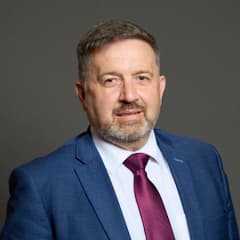
Robin Swann, Ulster Unionist MP for South Antrim since 2024 and the only UUP member in the House of Commons, arrived at Westminster with more governing experience than most backbenchers ever accumulate, and a reputation built almost entirely on one brief: health.
Born Robert Samuel Swann in Kells, County Antrim, in September 1971 and educated at Ballymena Academy, he came to politics from industry rather than the professions, working in inspection and testing and taking a BSc and a management certificate with the Open University while employed. That is a less polished route than the legal or communications careers common among frontline politicians, and it shows in a plain, managerial public manner that served him well in office.
His Stormont career was long and institutional, not merely a stepping stone. Elected MLA for North Antrim in 2011, he served thirteen years, including five as UUP Chief Whip from 2012, and chaired both the Public Accounts Committee and the Employment and Learning Committee. He led the party from April 2017 to November 2019, resigning after a poor 2019 general election and handing over to his deputy Steve Aiken. A leadership that ends in electoral failure is a real mark against him, but it was his ministerial work, not his party command, that defined him.
As Health Minister from January 2020 to October 2022 he became the public face of Northern Ireland's Covid response, and in 2022 Civility in Politics named him Politician of the Year for his conduct during the pandemic. His second term, brief at February to May 2024, was more concretely productive than its length suggests. He settled long running industrial action by health workers with a pay deal and launched longer term strategies for cancer care and mental health. The qualification is that two ministerial terms left the underlying health service still in structural crisis, a problem larger than any one minister.
In July 2024 he switched from North Antrim to contest South Antrim and won it on 16,311 votes, 37.85 per cent, with a majority of 7,512, or 17.5 per cent, unseating the DUP's Paul Girvan. The move across constituencies and the fact that he is the UUP's sole Westminster representative both temper the achievement. A single MP from a minor unionist party has limited leverage over a Labour government, and a strong personal majority does not by itself translate into influence.
At 54, with two ministerial terms, a national award and the healthcare settlement behind him, Swann has substance that most new MPs lack. The test is whether South Antrim sees visible delivery on health access, farming and public services from its sole Ulster Unionist voice, or whether the party's return to the Commons proves more symbolic than consequential.