
Political Biography
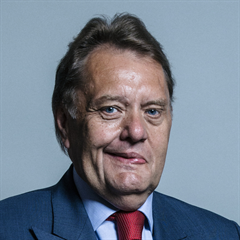
John Hayes has been MP for South Holland and The Deepings since 1997 and is the public face of the strain of Conservatism that calls itself common sense. He founded the Common Sense Group of Conservative MPs and peers in 2020 and has run it since. The name describes the politics. Whether the politics describe the country is the question his career has spent twenty seven years putting.
He came up from somewhere recognisable. The son of a Woolwich council estate who joined the Conservative Party at fourteen, took a degree in politics and a teaching qualification at Nottingham and spent thirteen years on the county council, Hayes is one of the more self made men on the right of his party. As a minister under Cameron and May he held junior posts at education, energy, transport and the Home Office over eight years, including the brief stint as an energy minister he marked by promising to put coal back into the coalition. He has chaired more public bill committees and Westminster Hall debates than almost anyone of his generation, the workhorse end of the chamber that gets little credit.
The Common Sense Group is what he will be remembered for. Founded in 2020 in conscious imitation of the European Research Group, it provides organisation to the strand of Conservative thinking that holds the country has gone wrong on history, statues, gender, policing and the National Trust. In November 2020 the group wrote an open letter to the Telegraph accusing the National Trust of being coloured by cultural Marxist dogma over its review of properties' connections to slavery and colonialism. Hayes has chaired it since, written its manifesto and given it the cohesion the Brexit caucus had a few years earlier. To his supporters this is the conscience of a Conservatism the establishment ignored. To his critics it is a culture war fought from inside the institutions, an attempt to refight the past in the language of grievance.
His personal record is, by ordinary measures, on the losing side of British social attitudes. He voted against same sex marriage and has voted on around fifteen occasions against the liberalisation of abortion access. He was knighted in November 2018 in an honour widely understood as a downpayment on his vote for Theresa May's Brexit deal, an interpretation he confirmed by voting against the deal anyway.
Then there is the money. From September 2018 he has been paid fifty thousand pounds a year as an adviser to BB Energy, an international oil trader, while he campaigned against the 2030 ban on petrol and diesel cars and, after a heatwave warning in July 2022, complained that Britain had become a cowardly new world frightened of the heat. The advisory work has not breached the rules. Whether it sits well with the role of a parliamentarian shaping climate policy is another question.
In 2024 he held South Holland and The Deepings with a majority of 6,856 over Reform UK, the rural Lincolnshire safe Conservative seat reduced to a battle with the populist right he has spent his career trying to channel.
Hayes is one of the more articulate social conservatives in modern Parliament, a man of genuine belief who has organised those beliefs into something his party has had to take seriously, and his work on apprenticeships and brain injury is to his credit. He is also a politician who took an oil firm's money while denouncing climate policy and a knighthood while planning to defy the leader who gave it to him. The conviction is real. The independence of it is the part to question.