
Political Biography
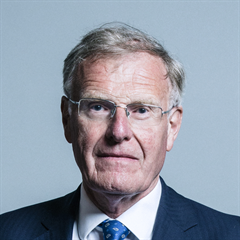
Christopher Chope has been MP for Christchurch since 1997 and for Southampton Itchen before that, and he is one of the few parliamentarians whose name is best known to the public for a single word, shouted from a back bench on a Friday afternoon. That word is object.
He started in the conventional Conservative way. A barrister who became leader of Wandsworth Council in his early thirties, he was awarded the OBE in 1982 for the Thatcherite shake up of London local government he had led, and was made a junior environment minister in 1986 and then a transport minister in 1990. He has not held government office in the thirty four years since he lost his seat in 1992. He came back in 1997 and has not budged from the back benches of either his own party or the procedural traditions of the House.
That, he would say, is the achievement. Chope's defining act in Parliament is the persistent use of a single MP's right to call object on a Friday afternoon, the day reserved for private members' bills that have not been timetabled for debate. His stated principle is that no change to the law of England should pass without proper scrutiny, and that bills bringing forward criminal offences or new state intervention should be debated rather than nodded through. The principle is defensible. The choices have been catastrophic for his reputation.
In June 2018 he objected to the second reading of a bill that would have made upskirting, the covert photographing under a woman's clothes, a criminal offence. The bill had cross party support and would have passed without contest. Theresa May said she was disappointed. The government brought it back as its own measure and it became law within a year. Months later he objected, twice, to a bill extending court protection orders to girls at risk of female genital mutilation. He was knighted the same month the upskirting row erupted, and the timing turned a routine honour into a national grievance. He has done the same to bills on revenge evictions, hospital parking charges for carers, the protection of police dogs and, in 2013, the posthumous pardon of Alan Turing.
His other entries in the public record are smaller and equally telling. During the expenses scandal he claimed eight hundred and eighty one pounds to repair a sofa, transported between London and his constituency. He continues to use the Friday slot to block bills he considers procedurally improper, including measures responding to standards reports against fellow Conservatives.
In 2024 he held Christchurch with a majority of 7,455, the Liberal Democrats in second and Reform UK close behind, a Dorset seat that had once been one of the safer Conservative greens in the country.
Chope is, in his way, the purest exponent of an old back bench tradition, the unbowed parliamentarian who refuses to let the House legislate for popularity. He is also the politician who used that principle to stop a bill against photographing up women's skirts on the day victims thought they would see justice. The procedure is not the offence. What he has chosen to apply it to is.