
Political Biography
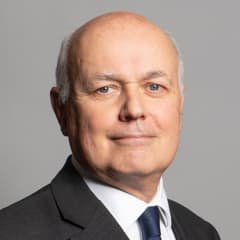
Iain Duncan Smith has been MP for Chingford and Woodford Green since 1992, succeeded Norman Tebbit in the seat, was Conservative leader for two years without fighting a general election, and spent six years rebuilding his reputation as the architect of the most ambitious welfare reform in a generation. He is one of the more consequential and one of the more wounding figures of his party's recent history, often the same week.
The leadership is now a punchline. Elected over Kenneth Clarke by the members in 2001, Duncan Smith never broke into double figures in the parts of the opinion polls his side cared about, was rocked by the Betsygate allegations about his wife's parliamentary expenses, and at the 2003 Blackpool conference delivered the line about a quiet man turning up the volume that has followed him around ever since. His own MPs removed him by ninety to seventy five in a confidence vote a fortnight later, the first Conservative leader since Neville Chamberlain not to lead the party into a general election.
What he did next was more impressive. In opposition he founded the Centre for Social Justice, the think tank that produced the case for what became Universal Credit, the simplification of six working age benefits into one. As Secretary of State for Work and Pensions under David Cameron from 2010 to 2016, he drove the reform with a conviction his department often struggled to match, and the National Audit Office found in 2013 that the IT effort had been so poorly managed it had to write off thirty four million pounds and start again. Universal Credit was rolled out across the country years later than promised. Independent research repeatedly linked its five week wait and sanctions regime to food bank use. The reform he had built to make work pay, in the parts of the country where it landed, did not always do that, and the human cost has been the lasting argument against it.
He left office in March 2016, resigning in protest at George Osborne's cuts to disability payments in that month's budget. His letter called them a compromise too far. Some read it as principle and some as Brexit positioning, since the budget row coincided with the run up to the referendum and the breakdown between him and Cameron. Both readings can be true.
He has since become one of the loudest Conservative voices on China, and in March 2021 Beijing imposed sanctions on him over the Xinjiang abuses he had publicly named, a designation he called a badge of honour. He was knighted in 2020, an honour that drew a petition against it of around two hundred and thirty thousand names.
In 2024 he held Chingford and Woodford Green with a majority of 4,757, Labour in second, his survival owed substantially to a split opposition between the official Labour candidate and the party's deselected predecessor.
Duncan Smith is sincere, prepared to be unpopular and the rare politician who has spent his post leadership years trying to do something rather than be something. He is also the architect of a welfare system that left poor people queuing at food banks while waiting weeks for the money to live, and a leader his own MPs threw out before he could fight an election. The achievement is real. So is the price others paid for it.